Useful Polish Phrases for Everyday Situations (with Videos and Pronunciation)
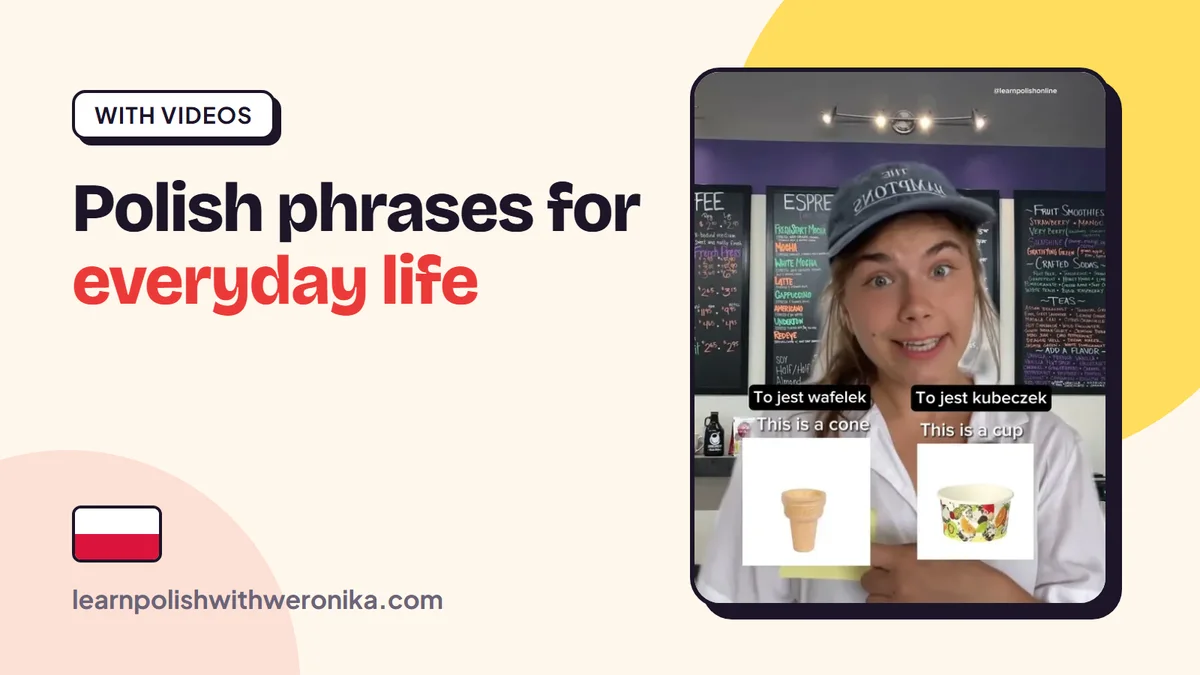
My short videos with everyday Polish dialogues – at the bakery, in a bar, in Żabka, at ticket control – have been watched millions of times. So I put the most useful ones in one place: the everyday Polish phrases for beginners, travellers and anyone living in Poland – each with an easy pronunciation guide, a short video so you can hear it, and a few tips I give my students. Think of it as survival Polish for real life. Watch the video, then say every phrase out loud: that is how it sticks.
In short
Most everyday situations in Poland need the same small set of phrases: Dzień dobry (hello), Poproszę… (I’d like…, please), Coś jeszcze? – To wszystko (Anything else? – That’s all), Kartą czy gotówką? (Card or cash?) and Dziękuję, do widzenia (Thank you, goodbye). Learn these first – then add the words for each place below.
10 common Polish phrases with pronunciation
These are the essential Polish phrases to know before anything else – you will use them everywhere. In the pronunciation column, the CAPITAL letters show the stressed syllable – in Polish it is almost always the second-to-last one.
| Polish | Say it like | English |
|---|---|---|
| Dzień dobry | jen DOH-bri | Hello / Good day (formal) |
| Poproszę… | po-PRO-sheh | I’d like…, please |
| Dziękuję | jen-KOO-yeh | Thank you |
| Przepraszam | pshe-PRA-sham | Excuse me / Sorry |
| Ile płacę? | EE-leh PWA-tseh | How much do I pay? |
| Kartą / Gotówką | KAR-tom / go-TOOF-kom | By card / In cash |
| To wszystko | to FSHIST-ko | That’s all |
| Nie rozumiem | nyeh ro-ZOO-myem | I don’t understand |
| Czy może pan / pani powtórzyć? | chih MO-zheh pan / PA-nee pof-TOO-zhitch | Could you repeat that? (to a man / a woman) |
| Do widzenia | do vee-DZEN-ya | Goodbye |
Want to hear the sounds properly? My guide to the Polish alphabet and pronunciation explains sz, cz, rz, ą, ę and ł step by step, and my list of 50 basic Polish words and phrases gives you the single words behind them.
At the bakery (piekarnia)
Your first taste of ordering food in Poland – and the bakery is the easiest place to practise.
| Polish | Say it like | English |
|---|---|---|
| Co podać? | tso PO-dach | What can I get you? |
| Dwie bułki, poproszę. | dvyeh BOOW-kee, po-PRO-sheh | Two bread rolls, please. |
| Ten po prawej. | ten po PRA-vey | The one on the right. |
| Pokroić? | po-KRO-eech | Shall I slice it? |
| Kawałek tego ciasta. | ka-VA-wek TEH-go CHAS-ta | A piece of this cake. |
| Torebkę doliczyć? | to-REP-keh do-LEE-chitch | Shall I add a bag (to the bill)? |
Teacher’s tip: you don’t need the name of every bread. Point and say ten (this one) or ten po prawej / po lewej (the one on the right / on the left). And yes – a plastic bag usually costs extra, so expect the question Torebkę doliczyć? This is also how to order food in Polish anywhere: Poproszę + what you want.
In a café, bar or restaurant: how to order drinks (and the WiFi password)
| Polish | Say it like | English |
|---|---|---|
| Czy mogę przyjąć zamówienie? | chih MO-geh PSHI-yonch za-moo-VYEN-yeh | Can I take your order? |
| Dla mnie… | dla mnyeh | For me… |
| Kieliszek czerwonego wina. | kyeh-LEE-shek cher-vo-NEH-go VEE-na | A glass of red wine. |
| Piwo z beczki czy w butelce? | PEE-vo z BECH-kee chih v boo-TEL-tseh | Draught or bottled beer? |
| Jakie jest hasło do wifi? | YA-kyeh yest HA-swo do WEE-fee | What is the WiFi password? |
| Coś jeszcze dla państwa? | tsosh YESH-cheh dla PAHN-stva | Anything else for you (all)? |
| Poproszę rachunek. | po-PRO-sheh ra-HOO-nek | The bill, please. |
Teacher’s tip: these are also the most useful Polish restaurant phrases – and the video shows exactly how to order beer in Polish: z beczki (draught) or w butelce (bottled). Dla mnie… (For me…) is the easiest way to order for yourself when you are with friends – each person just says Dla mnie and the drink. And państwo is the polite way to address a group: Coś jeszcze dla państwa?
Ordering ice-cream: cone or cup?
| Polish | Say it like | English |
|---|---|---|
| Poproszę dwie gałki lodów. | po-PRO-sheh dvyeh GAW-kee LO-doof | Two scoops of ice-cream, please. |
| Jakie smaki? | YA-kyeh SMA-kee | Which flavours? |
| Czekoladowe i truskawkowe. | che-ko-la-DO-veh ee troo-skaf-KO-veh | Chocolate and strawberry. |
| W wafelku czy w kubeczku? | v va-FEL-koo chih f koo-BECH-koo | In a cone or in a cup? |
| Przepraszam, co to znaczy…? | pshe-PRA-sham, tso to ZNA-chih | Sorry, what does … mean? |
| Normalny. | nor-MAL-nih | A normal one (the cone included in the price). |
Teacher’s tip: don’t be surprised by Który wafelek? (Which cone?) – many ice-cream shops have a normal cone and fancier ones that cost extra. If you don’t understand a word, Przepraszam, co to znaczy…? is one of the most useful questions you can learn.
In Żabka, the Polish convenience store
The Polish shopping phrases you need at any till – in Żabka, a supermarket or a kiosk.
| Polish | Say it like | English |
|---|---|---|
| Poproszę zapiekankę. | po-PRO-sheh za-pye-KAN-keh | A zapiekanka (baked baguette), please. |
| Trzeba poczekać 10 minut. | TSHE-ba po-CHE-kach JEH-shench MEE-noot | You need to wait 10 minutes. |
| Aplikacja Żabki jest? | a-plee-KATS-ya ZHAP-kee yest | Do you have the Żabka app? |
| Nie, nie mam. | nyeh, nyeh mam | No, I don’t. |
| Kartą czy gotówką? | KAR-tom chih go-TOOF-kom | Card or cash? |
| Może być bez grosza? | MO-zheh bitch bez GRO-sha | Is it OK without the 1 grosz (change)? |
Teacher’s tip: Żabka is everywhere in Polish cities, and the cashier almost always asks about the app – a simple Nie, nie mam is enough. When the price is something like 39,99 zł and you pay in cash, you may hear Może być bez grosza?: they are asking if they can skip the 1-grosz change.
Ticket control on public transport
Polish travel vocabulary you will hear on trains, trams and buses – and what to answer.
| Polish | Say it like | English |
|---|---|---|
| Bilety do kontroli. | bee-LEH-tih do kon-TRO-lee | Tickets, please (ticket inspection). |
| Ma pani / pan bilet? | ma PA-nee / pan BEE-let | Do you have a ticket? (to a woman / a man) |
| Proszę jeszcze legitymację. | PRO-sheh YESH-cheh le-gee-tih-MATS-yeh | Your ID card too, please (e.g. a student card for a reduced ticket). |
| Przepraszam, nie wiedziałem / wiedziałam. | pshe-PRA-sham, nyeh vye-JA-wem / vye-JA-wam | Sorry, I didn’t know. (said by a man / a woman) |
| Nie mówię dobrze po polsku. | nyeh MOO-vyeh DOB-zheh po POL-skoo | I don’t speak Polish well. |
| Bilet normalny. | BEE-let nor-MAL-nih | A full-price ticket. |
Teacher’s tip: bilet normalny is the full-price ticket and bilet ulgowy the reduced one – which is why inspectors ask for your legitymacja when you have a reduced ticket. Ticket rules differ from city to city and between trains and buses, so check how to buy a ticket before you travel.
Bonus: Fat Thursday doughnuts (pączki)
| Polish | Say it like | English |
|---|---|---|
| Poproszę dwa pączki. | po-PRO-sheh dva PONCH-kee | Two doughnuts, please. |
| Z czym? | s chim | With what (filling)? |
| Jeden z różą, jeden z dżemem. | YEH-den z ROO-zhom, YEH-den z JEH-mem | One with rose jam, one with jam. |
| Polecam również faworki. | po-LEH-tsam ROOV-nyesh fa-VOR-kee | I also recommend faworki (angel wings). |
| Pół kilo faworków. | poow KEE-lo fa-VOR-koof | Half a kilo of faworki. |
| Proszę zbliżyć kartę. | PRO-sheh ZBLEE-zhitch KAR-teh | Please tap your card. |
Teacher’s tip: on tłusty czwartek (Fat Thursday, the last Thursday before Lent) Poles eat pączki everywhere – and the queues are long. Classic fillings are z różą (rose jam) and z dżemem (jam), but you will see many more.
Pan, pani, państwo: why everyone sounds so polite
You may notice that staff never say “you” the casual way. In shops, cafés and on trains they use pan (sir), pani (madam) and państwo (you, to a group): Ma pani bilet?, Coś jeszcze dla państwa? As a beginner you don’t have to use it yourself – Dzień dobry, poproszę and dziękuję are always polite. But understanding it helps you follow what people say to you.
From phrases to real conversations
Phrases get you through the bakery. To understand the answers, ask your own questions and chat with your neighbours, you need the grammar behind them – the cases that change bułka into dwie bułki, and the verbs that change with every person. That is exactly what my A1 course for people living in Poland teaches, step by step and explained in English: everyday situations like these, with exercises after every lesson. Not sure where to start? Take the free Polish level test.
Frequently Asked Questions
What are the most useful Polish phrases for tourists?
Start with these: Dzień dobry (hello / good day), Poproszę… (I'd like…, please), Dziękuję (thank you), Przepraszam (excuse me / sorry), Ile płacę? (how much do I pay?), Kartą (by card), To wszystko (that's all), Nie rozumiem (I don't understand) and Do widzenia (goodbye). With these you can handle a shop, a café and a bakery.
How do you say please and thank you in Polish?
Proszę means please – and also here you are and you're welcome. When you order or ask for something, Polish people usually say poproszę: Poproszę kawę (A coffee, please). Thank you is dziękuję (jen-KOO-yeh).
How do you order food in Polish?
Say poproszę and what you want: Poproszę dwie bułki (Two bread rolls, please). For a group or a table you can say Dla mnie… (For me…). When the staff ask Coś jeszcze? (Anything else?), answer To wszystko, dziękuję (That's all, thank you).
How do I say I want to pay by card in Polish?
You will often hear Kartą czy gotówką? (Card or cash?). Answer Kartą (by card) or Gotówką (in cash). When the card machine is ready, the cashier may say Proszę zbliżyć kartę – please tap your card.
What does Co podać? mean?
It means What can I get you? – it is what shop assistants and bakery staff say when it is your turn. You can answer straight away with Poproszę… and what you want.
Should I say pan or pani?
In shops, cafés and on public transport, staff address customers formally: pan for a man, pani for a woman (for example Ma pani bilet? – Do you have a ticket, madam?). You don't need to use it yourself as a beginner – Dzień dobry, poproszę and dziękuję are always polite.
Living in Poland?
Speak Polish in everyday life – step by step
My A1 course for people living in Poland takes you from zero to everyday conversations: 86 video lessons (22 hours), exercises after every lesson and an offline app. With VIP, a teacher checks your speaking and writing for 6 months. One-time payment, lifetime access and a 14-day money-back guarantee.