Duolingo Polish Review (2026): Is It Worth Your Time?

“I did Duolingo for a while.” I hear this from new students almost every week. I have taught Polish to people from 70+ countries for more than 10 years, and the green owl is where a large share of them started. So, is Duolingo good for Polish? I first wrote this review in 2023; this is the updated 2026 version, with what the course looks like, what it does well and what it quietly skips.
In short
Duolingo is a decent, free way to pick up your first few hundred Polish words and build a daily habit. It is not a way to learn to speak Polish: the English–Polish course is one of the app’s smallest, it stops at A1, it never explains the reading rules or the cases, and nobody checks how you actually sound. Use it as a warm-up, not as the plan. When you want to hold a real conversation, you need a structured course or a teacher.
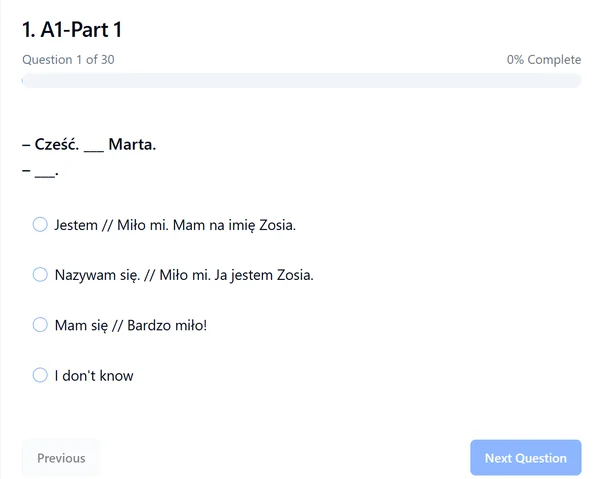
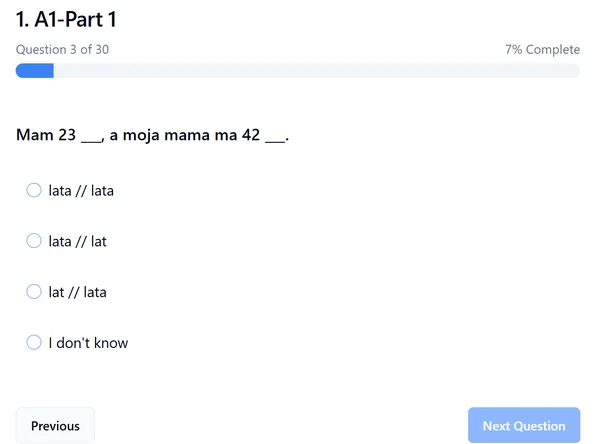
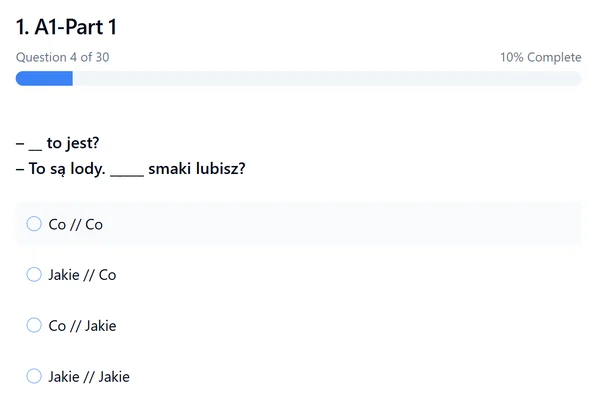
What level did Duolingo get you to?
Take my free level test – about 10 minutes, and you’ll know where you really stand.
Take the free level testCan you learn Polish on Duolingo?
You can learn some Polish on Duolingo: a few hundred words, the shape of common sentences and a feel for how the language sounds. You cannot learn to speak Polish on Duolingo alone. The app trains recognition – tap the right tile, pick the right translation – while speaking needs production: choosing the right ending yourself, out loud, with a real person waiting. Those are different skills, and the second one is the one you will need in Poland.
That is why so many of my students arrive after months of streaks knowing that dziewczynka means “a girl” but unable to order a coffee or say where they are from without panicking. The app did not teach them wrong things; it taught them one narrow thing and let them believe it was the whole language. (If Polish’s reputation is part of what keeps you on the app, read is Polish hard to learn? – the honest answer is less scary than the memes.)
What does the Duolingo Polish course include in 2026?
Duolingo has one Polish course, for English speakers, and it is small. In the latest public course snapshot the path has three sections, which the course data labels “Intro” and A1 – there is nothing at A2 or above (Duolingo Data, course snapshot from July 2025). Duolingo Data counts 67 units and about 1,100 lessons in that snapshot, and the Polish course has no Stories. In practice you get vocabulary and sentence drills, a short grammar tip per unit and listen-and-type exercises.
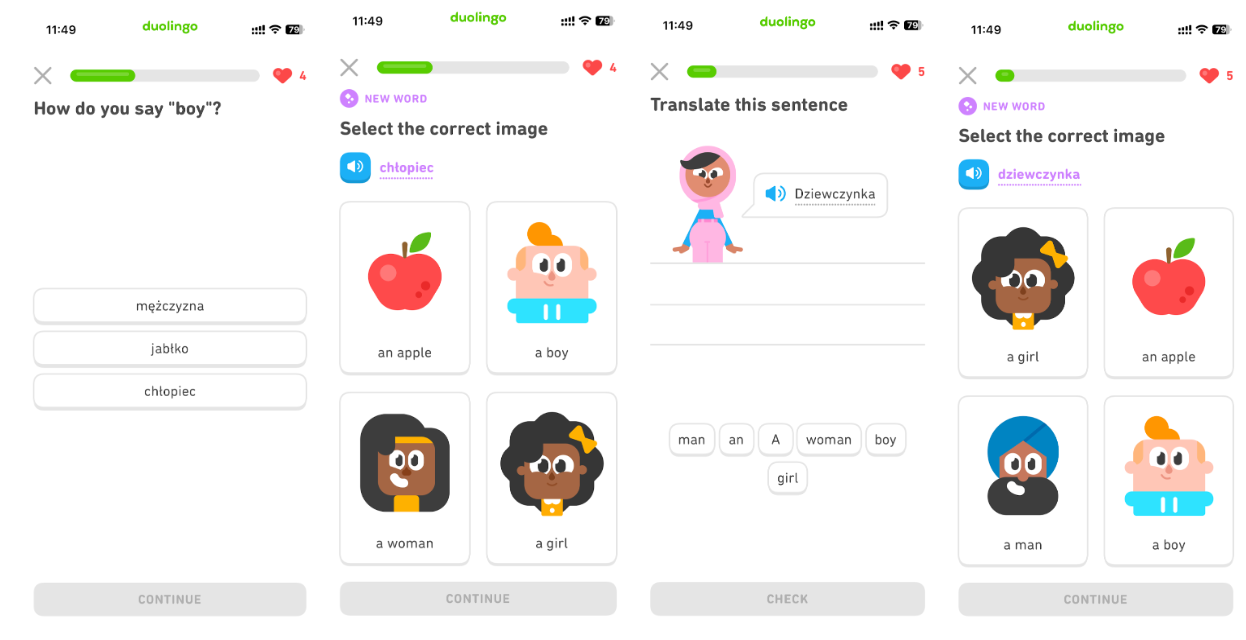
The exercise types will be familiar if you have used the app for any language: match the picture to the word, build a sentence from word tiles, type what you hear, translate a sentence in both directions. The free version shows ads and limits how much you can do before you wait or watch an ad; a paid plan removes the limits but does not make the Polish course any bigger. The extras that make the big courses feel rich – Stories and podcasts – are not there for Polish.
How long does it take to learn Polish on Duolingo?
Longer than most people expect – and it still stops at A1. A1 takes about 90–120 hours of study from zero; at 10–15 minutes a day that is a year or more of streaks, and the app spends that time on recognition, not speaking. Studying 3–5 hours a week with a structured course, most students complete A1 in about 4–6 months.
Finishing the app is not the goal anyway. The whole Polish path is labelled A1, so the best realistic outcome of completing it is A1-level recognition: a few hundred words, simple written sentences you understand, endings you recognise when you see them. A1 conversation – introducing yourself, ordering food, asking for directions and understanding the answer – needs speaking practice the app does not give you.
I say this without judgement. Recognition is a real first step, and a student who already knows kawa, dziękuję and nie rozumiem starts my A1 course with a head start. Just do not plan your move to Kraków around a finished Duolingo path.
What Duolingo does well for Polish
Credit where it is due: for a free app, Duolingo gets a few important things right, and I happily recommend it to students who want a low-pressure way to start. It is good at making you come back every day, at drilling high-frequency words until they stick and at letting you hear Polish from the first minute.
- It is free and frictionless. No decision to make, no money at risk, five minutes on the bus. For a language with Polish’s reputation, lowering the entry bar matters.
- The habit. Streaks are silly and they work. Daily contact with the language beats one long session a week – it is the same reason my lessons are short.
- Vocabulary in sentences. You meet words in context, not in lists, which helps them stick. I teach vocabulary the same way.
- Audio for everything. Every word and sentence is spoken, and the listen-and-type exercises are genuinely good for training your ear.
- A gentle warm-up. Students who come from Duolingo already know some words and are not scared of the alphabet, which makes their first real lessons easier.
Where Duolingo falls short for Polish
Duolingo’s weaknesses are the same in every language, but Polish punishes them harder. Polish has reading rules you must learn before anything else, seven cases that change the ending of almost every word, and sounds that are easy once explained and baffling when nobody explains them. Duolingo explains none of this, and it never really hears you speak. Here is where that shows.
It never teaches you how to read Polish
Back in 2023, the very first screen the app showed me was a quiz with the word dziewczynka (“a girl”). You get the audio, but nobody tells you how the letters work, so a complete beginner reads it as something like “dee-vee-ech-ZINK-uh” and moves on.
The real pronunciation is closer to “jef-CHIN-ka”, with the stress on the middle syllable, because:
- dzi → a soft “j”, like the start of “jeans”
- w → “v” (and in this word it slides into an “f” before cz)
- cz → “ch”, as in “chip”
- y → a short “i”, as in “bit”
Polish spelling is very regular – far more than English. Once you know the special letters (ą, ę, ó, ł, ń, ś, ź, ż, ć) and a handful of two-letter combinations, you can read almost anything, and the stress almost always falls on the second-to-last syllable. It takes one lesson. Duolingo skips that lesson, so many learners spend months silently mispronouncing every word they “learn”.
Why Polish grammar is so hard to learn on an app
Polish nouns, adjectives and pronouns change their endings depending on their role in the sentence – that is the case system, and it is the heart of the language. Duolingo shows you kawa in one exercise and kawę in the next without telling you why; you are supposed to “feel” the pattern. There are a few short tips, but no step-by-step walkthrough of the nominative, accusative, genitive and the rest – which is exactly what a beginner needs to stop guessing. In my experience, students who learned this way can often spot a correct sentence but cannot build one. If the endings never clicked for you, start with my 7 Polish cases explained simply, with a free chart.
No one hears you speak
Speaking exercises are scarce in the Polish course, and whatever the app does check, it checks by machine: it can tell you that you were roughly close to the recording, not that your ś sounds like sz or that you stressed the wrong syllable. (Babbel, which also offers Polish, at least uses speech recognition from the first lesson, but a machine still cannot tell you why.) A person listening and telling you what to fix is the one thing I have never seen an app replace. It is why the VIP plan of my courses includes 6 months of real teacher feedback on recorded voice and written exercises: you send a recording like the one below and get corrections from a real teacher, not a score.

The sentences are random
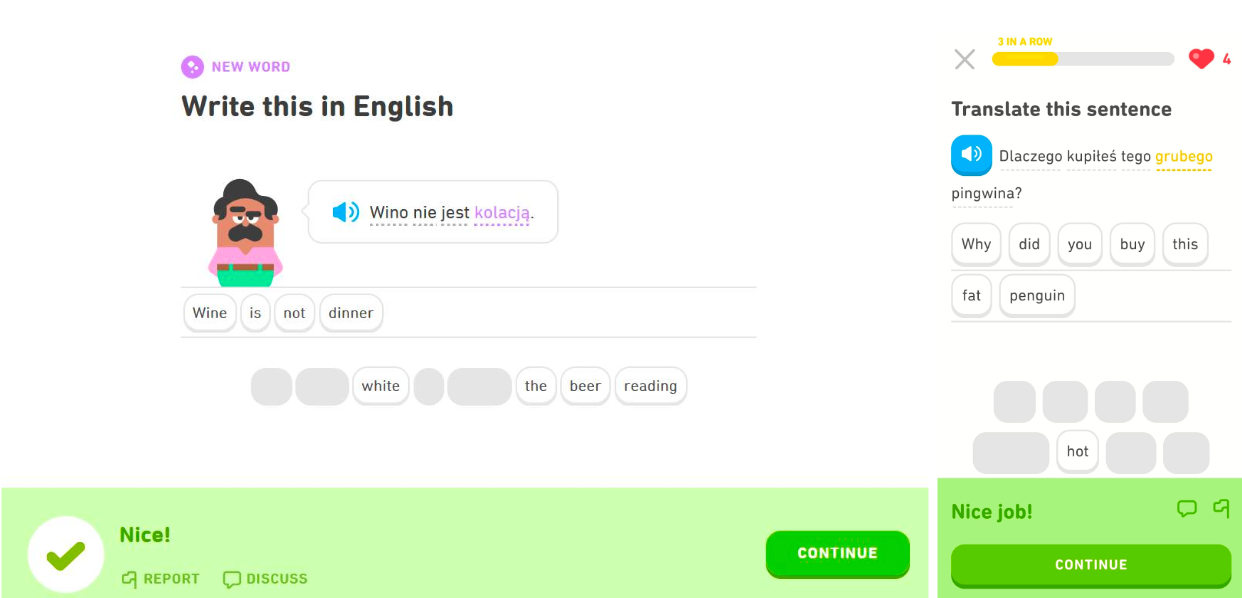
Because the app drills patterns rather than topics, many sentences exist only to show a pattern, and some of them are gloriously useless. My personal favourites are Wino nie jest kolacją (“Wine is not dinner”) and Dlaczego kupiłeś tego grubego pingwina? (“Why did you buy this fat penguin?”). They make good memes, but you will never need to say them, and the vocabulary is not organised around what an A1 learner actually needs: greetings, numbers, food, family, directions, time.
What about other apps for learning Polish?
Duolingo is not the only app with Polish – Babbel, Memrise, Drops and others offer it too, and new ones appear every year. I won’t rank them: apps change their courses often, and the right one is simply the one you open every day. What matters for Polish is the same for every app, so here is the checklist I give my students. Ask these four questions before you invest months:
- Does it explain the cases? Not just show different endings, but tell you step by step why kawa becomes kawę or kawy.
- Does it go beyond A1? Check whether there is real A2 and B1 material, or only beginner vocabulary.
- Does a real person ever hear you? A score from speech recognition is not the same as a teacher telling you what to fix.
- Does it follow the CEFR levels? A clear A1 → A2 → B1 path tells you where you are and what comes next.
Most apps pass one or two of these, and that is fine – use them for words and a daily habit. For the rest, add a structured course or a teacher. If you want the whole step-by-step plan, read my guide on how to learn Polish from zero.
Duolingo vs a video course vs private lessons
Here is how the three most common ways to learn Polish compare on the things my students ask about. “Structured video course” means a self-paced course that follows the CEFR levels, like mine; “private lessons” means one-to-one with a teacher, online or in person.
| What you get | Duolingo | Structured video course | Private lessons |
|---|---|---|---|
| Price | Free with ads; a paid plan removes the limits | One-time payment, lifetime access (A1 Part 1 from €137) | Paid per lesson, for as long as you learn |
| Grammar explained | Short tips, no walkthrough of the cases | Yes – every rule explained step by step, then practised | Yes, if the teacher plans it |
| Speaking feedback | Machine-checked, scarce for Polish | VIP: 6 months of real teacher feedback on voice and written exercises | Yes, live in every lesson |
| CEFR structure | Whole course labelled A1 | A1 → A2 → B1, level by level | Depends on the teacher |
| Time to first conversations | Not designed for it | You build and say sentences from the first lessons | Fast, if you practise between lessons |
| Certificate | No | Certificate of completion | Usually no |
Weighing private lessons against a course? I compare cost, structure and speaking practice in Polish tutor or online course? An honest comparison.
How to use Duolingo for Polish the smart way
If you enjoy the app, keep it – just give it the job it is good at. Use Duolingo for daily vocabulary contact, five to ten minutes, and get the reading rules, grammar and speaking from somewhere that explains them. Five habits make the difference.
- Learn the alphabet first. Spend one evening on the special letters and the two-letter combinations (sz, cz, rz, dz, ch). After that, say every Duolingo word out loud, stress on the second-to-last syllable.
- Say it, don’t tap it. Before you touch the tiles, say the whole sentence aloud, then check. Tapping trains recognition; saying trains speaking.
- Ask “why this ending?” When kawa turns into kawę, do not swipe past it. Write the sentence down and look up the case behind it – or ask a teacher.
- Add real Polish audio. Ten minutes a day of a Polish song, podcast or children’s cartoon teaches rhythm and natural speed in a way computer voices cannot.
- Set a finish line. Decide now: “When I reach this point, I start a proper course.” Otherwise the streak becomes the goal and the language quietly stops being one.
What to do after Duolingo
When the tiles stop feeling like progress, do four things: take the level test, start a structured A1 course, check the words you already know and see what A1 actually covers. Most ex-Duolingo students are not “done with A1” – they are A1 with gaps in reading, grammar and speaking – so the right next step is usually the beginning of a real A1 course, which will feel fast because the vocabulary is familiar.
- Take the free level test. My level test takes a few minutes and tells you honestly where you stand, so you do not pay for the wrong level.
- Start with A1 Part 1. A1 Part 1 is 86 video lessons (22 hours) that explain the reading rules, the first cases and the verbs you need, with interactive exercises, flashcards, audio sentences, printable PDFs and a mobile app with offline mode. It is a one-time payment with lifetime access and a 14-day money-back guarantee. To finish the whole A1 level in one go, the A1 bundle adds Part 2.
- Check the words you already know. Go through my 50 basic Polish words every beginner should know and make sure you can say every one of them out loud, not just recognise it.
- See what A1 actually covers. My A1 guide lists the nouns, cases and verbs an A1 course has to teach, so you can see the gaps the app left.
All my courses, from A1 to B1, and the bundles are on the page with my online Polish courses. 15,000+ students have learned Polish with me, and the courses are rated 4.9 on Trustpilot – here is what some of them say:
So, is Duolingo worth your time for Polish? As a warm-up, yes – enjoy the owl. As the plan, no. The sooner you add structure and a real human ear, the sooner dziewczynka stops being a tile you tap and becomes a word you can say.
Frequently Asked Questions
Is Duolingo Polish free?
Yes. The Polish course is part of Duolingo’s free plan: you get every lesson, with ads and a limit on how much you can do before you wait or watch an ad. The paid plans remove the ads and the limits, but they do not add any Polish content – the course is the same size either way.
Does Duolingo have a Polish course for English speakers?
Yes, one: Polish for English speakers. It is one of the smaller courses on the app – in the latest course snapshot (July 2025) it has three sections labelled Intro and A1, no Stories and nothing at A2 or B1 level.
Can Duolingo get me to B1 or help me pass the Polish State Exam?
No. The Polish path stops at A1, and the B1 exam tests writing, listening, reading and a live speaking part – none of which the app trains. If the exam is your goal, read my B1 Polish State Exam guide and plan a structured A1 to B1 path first.
Does Duolingo teach Polish grammar and cases?
Only by exposure. You will see different endings on the same word and a few short grammar tips, but there is no step-by-step explanation of the seven cases, verb conjugation or aspect. Most learners can recognise correct forms afterwards but cannot produce them.
What is the best app to learn Polish?
There is no single best app – most apps, like Duolingo, Babbel, Memrise or Drops, are good for a daily vocabulary habit. For Polish, check four things: does it explain the seven cases step by step, does it go beyond A1, does a real person ever correct your speaking, and does it follow the A1 → A2 → B1 levels? If not, use the app you enjoy for words and add a structured course for grammar and speaking.
Duolingo or a course for Polish?
Both, side by side. If Duolingo keeps you motivated, use it for daily vocabulary. For reading rules, grammar and speaking you need a structured course or a teacher. My A1 Part 1 course is built to be exactly that next step, and it comes with a 14-day money-back guarantee.
After Duolingo
From app streaks to real conversations
My 86-lesson A1 Part 1 course takes you step by step from zero to your first real conversations in Polish – video lessons, interactive exercises, audio sentences and a mobile app, with a 14-day money-back guarantee.