Learn Polish for Your Polish Heritage: Reconnect with Your Family’s Language
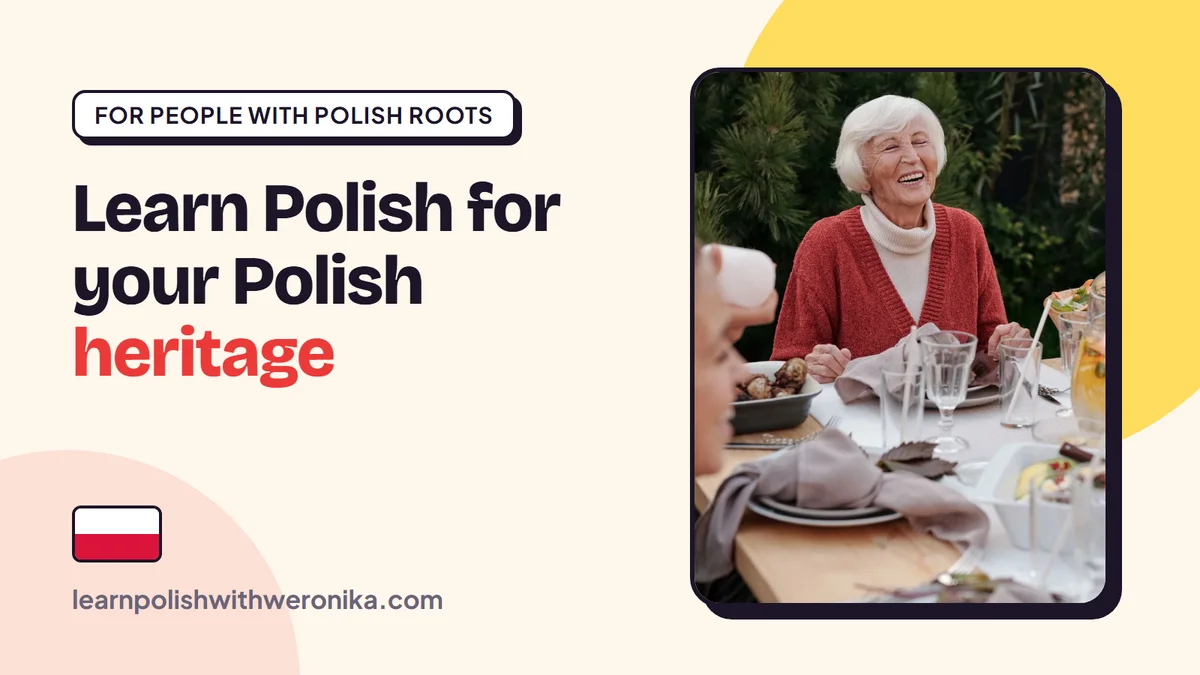
Maybe your babcia spoke Polish in the kitchen. Maybe your parents switched to Polish when they didn’t want the kids to understand. You heard Smacznego at every Sunday dinner and Sto lat at every birthday.
But you never really learned it. And now you want it back.
People with Polish roots – in America, Canada, Britain – often tell me the same things. They want to talk to relatives in Poland. Read the old letters. Visit the village their family came from. Or simply feel that this part of them is not lost.
In this guide, I will show you where to start: the family words, the phrases you probably heard at home, your family name – and a simple plan.
Already know you want to learn properly? Here is my beginner course (A1) for people with Polish roots.
In short
Start with the words you already have: babcia (grandma), dziadek (grandpa), Smacznego (enjoy your meal), Na zdrowie (cheers). Then learn how Polish sounds work, so you can read your family name and old letters. Then build real sentences step by step with a structured course. 15 minutes a day is enough.
Why so many people with Polish roots learn Polish now
- Family in Poland. Cousins you have never really talked to. A video call without translating.
- A trip to the family village. Walking where your great-grandparents walked – and asking the locals in Polish.
- The old letters and documents. Birth certificates, postcards, a recipe in grandma’s handwriting.
- The holidays. Wigilia, the Easter basket, Sto lat – and understanding the words, not just the tune.
- Your kids. Passing something on before it disappears from the family.
Heritage learner or total beginner?
If you grew up around Polish, you are probably somewhere in between:
- You understand more than you think. Words like jedz (eat), chodź tu (come here) or dobranoc (good night) feel like home.
- The sounds are familiar. sz, cz, rz – you heard them for years. That is a big advantage.
- But you can’t build sentences. That is normal. Polish grammar – the endings, the cases – needs structure, not just listening.
Not sure where you are? Take the free Polish level test. It takes a few minutes.
Polish family words
| Polish | Say it like | English |
|---|---|---|
| rodzina | ro-JEE-na | family |
| babcia | BAB-cha | grandma |
| dziadek | JA-dek | grandpa |
| prababcia / pradziadek | pra-BAB-cha / pra-JA-dek | great-grandma / great-grandpa |
| mama / tata | MA-ma / TA-ta | mom / dad |
| ciocia / wujek | CHO-cha / VOO-yek | aunt / uncle |
| kuzyn / kuzynka | KOO-zin / koo-ZIN-ka | cousin (male / female) |
| korzenie | ko-ZHEH-nyeh | roots |
Teacher’s tip: say Moja rodzina jest z Polski (MO-ya ro-JEE-na yest s POL-skee) – my family is from Poland. Relatives in Poland will love that sentence.
The Polish you probably heard at home
At a Polish family table, some phrases come up again and again – at Christmas most of all.
| Polish | Say it like | English |
|---|---|---|
| Smacznego! | smach-NEH-go | Enjoy your meal! |
| Jedz, jedz! | yets, yets | Eat, eat! |
| Weź jeszcze! | vesh YESH-cheh | Take some more! |
| Na zdrowie! | na ZDRO-vyeh | Cheers! / Bless you! |
| Sto lat! | sto lat | A hundred years! (the birthday song) |
| Kocham cię. | KO-kham cheh | I love you. |
| Dobranoc. | do-BRA-nots | Good night. |
And the food. You probably say these the American way – here is how they sound in Polish:
| Polish | Say it like | What it is |
|---|---|---|
| pierogi | pyeh-RO-gee | dumplings |
| gołąbki | go-WOMP-kee | cabbage rolls |
| kiełbasa | kyew-BA-sa | sausage |
| barszcz | barshch | beetroot soup |
| pączki | PONCH-kee | doughnuts (one is a pączek) |
| chrust / faworki | khroost / fa-VOR-kee | angel wings |
Your family name in Polish
Many family names that look impossible in English are easy once you know a few letter combinations:
- sz = “sh”, cz = “ch”, rz = like the “s” in “pleasure”.
- w = “v”, and ł = “w”. So Wałęsa is “va-WEN-sa”.
- -ski and -ska: in Polish, the ending changes with gender. Mr Kowalski, Mrs Kowalska. Your great-grandmother may have been a -ska.
All the letters, with sounds, are in my Polish alphabet and pronunciation guide.
Polish traditions you may know from home
- Wigilia – Christmas Eve supper on 24 December, with the first star and the opłatek wafer. Here is everything about Wigilia.
- Pączki – in Poland the day is Tłusty Czwartek, Fat Thursday. In many American cities, Paczki Day is Fat Tuesday.
- Święconka – the Easter basket blessed on Holy Saturday.
- Dyngus Day – Śmigus-dyngus, the water fight on Easter Monday. Buffalo, New York, is famous for it.
- Name days – in Poland, many people celebrate their imieniny as much as their birthday. Here is what name days are and what to say.
Christmas with the family soon? Learn a few words now and wish everyone Wesołych Świąt in Polish. Here are my Christmas wishes in Polish – for family, friends and the card to Poland.
Where to start: a simple plan
- The soundsLearn how Polish letters sound, so you can read anything – your name, a street sign, an old letter.
- The family words and table phrasesThe ones in this guide. Use them with your family this week.
- Real sentences, step by stepThis is where a structured course helps: greetings, introducing yourself, family, food and small talk – in the right order.
- 15 minutes a dayShort and every day beats a long session once a week.
- Practice with familyA short video call in Polish. They will be patient – and proud.
Thinking about Polish documents too? I am a language teacher, not a lawyer – for papers, please check with your consulate. If you are preparing for a Karta Polaka interview, here is how to prepare the language part.
Learn Polish for your roots – with me
I am Weronika, a Polish teacher from Wrocław. My beginner course (A1) for people with Polish roots takes you from zero – or from the few words you remember – to your first real conversations. Short video lessons, explained in English, step by step.
Rated 4.9 out of 5 from 102 reviews on Trustpilot.
Pick your start:
- Made for you: the beginner course (A1) for people with Polish roots.
- The whole beginner level: the beginner bundle (A1 Part 1 and 2, 34 hours).
- All in: the zero to B1 bundle (78+ hours) – from your first word to real conversations.
Pay once. Keep it forever. 14-day money-back guarantee. Powodzenia! – good luck!
Frequently Asked Questions
Is it too late to learn Polish as an adult with Polish roots?
No. Adults learn languages at any age – with a clear plan and a little practice every day. If you heard Polish as a child, the sounds already feel familiar – that is a real head start.
I understand some Polish but can’t speak. Why?
Understanding and speaking are different skills. You heard Polish, but you never had to build sentences. With a little structure – grammar step by step and speaking out loud – the words you already know start to come out.
What do babcia and dziadek mean?
Babcia (BAB-cha) is grandma and dziadek (JA-dek) is grandpa. Many Polish-American families still use these words, even when the rest of the family speaks English.
Why do Polish surnames end in -ski or -ska?
In Polish, many surnames change with gender: Mr Kowalski, Mrs Kowalska. Abroad, families often kept only one form – so your great-grandmother may have been a Kowalska.
How long does it take to talk with relatives in Poland?
Simple, real conversations are the A1 level – about 4–6 months with a course and a little practice every day. Heritage learners often go faster, because they already know many words and sounds.
Can I learn Polish online if there is no Polish school near me?
Yes. A structured online course gives you the grammar and the pronunciation step by step, and video calls with family give you the practice. Together, that works.
For people with Polish roots
Speak the language of your family
My beginner course (A1) for people with Polish roots starts from zero – or from the few words you remember. Short video lessons, explained in English, step by step – with exercises after every lesson and an app. One-time payment, lifetime access and a 14-day money-back guarantee.