Polish Name Days (Imieniny): What They Are, How Poles Celebrate and What to Say
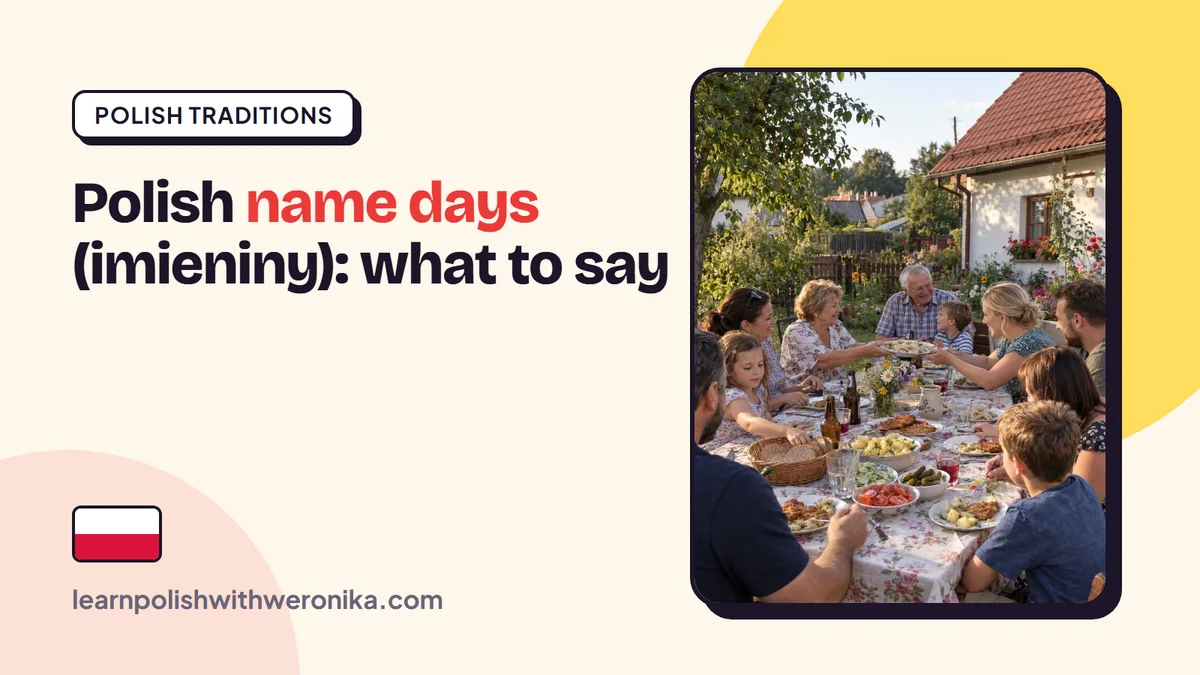
In Poland, many people have two special days a year. Their birthday – and their name day.
A name day, imieniny, is the day in the calendar that belongs to your first name. Every day has a few names. And on yours, the phone rings, colleagues bring flowers and somebody starts singing Sto lat.
If you have a Polish partner, Polish family or Polish colleagues, name days are a small thing that makes a big impression. Remember one, say one sentence in Polish – and you are suddenly “one of us”.
In short
A Polish name day (imieniny, ee-myeh-NEE-nih) is the calendar day of your first name. Poles celebrate it with wishes, flowers, cake and the song Sto lat. Say Wszystkiego najlepszego z okazji imienin! – all the best on your name day. The capital letters show where to put the stress.
What is a name day?
Name days come from the Catholic calendar of saints. Each day of the year has the names of a few saints – and everyone with that name celebrates.
- Every Polish calendar shows them. Under the date, you will see a few names. That is how people remember.
- Some names have several dates. Then the family picks one and keeps it.
- For older Poles, it is often the bigger day. A birthday is private. A name day is in the calendar – everyone knows it.
How Poles celebrate name days
- Wishes. A phone call, a message, a card – or a big hug.
- Flowers. In Poland, give an odd number of flowers: 3, 5, 7. Even numbers are for funerals.
- Cake at work. The person with the name day brings cake or sweets for the whole office.
- Family coffee and cake. At home, the family comes for kawa i ciasto – coffee and cake – or a big dinner.
- The song. Everyone sings Sto lat. Its words are below.
What to say on a Polish name day
Most name-day wishes are the same as for a birthday – just with imienin instead of urodzin.
| Polish | Say it like | English |
|---|---|---|
| Wszystkiego najlepszego z okazji imienin! | fshist-KYEH-go nay-lep-SHEH-go z o-KAH-zyee ee-MYEH-neen | All the best on your name day! |
| Sto lat! | sto lat | A hundred years! |
| Dużo zdrowia! | DOO-zho ZDRO-vya | Lots of health! |
| Zdrowia, szczęścia, pomyślności! | ZDRO-vya, SHCHENSH-cha, po-mish-L-NOSH-chee | Health, happiness, success! |
| Spełnienia marzeń! | spew-NYEH-nya MA-zhen | May your dreams come true! |
And two useful ones around the name day:
| Polish | Say it like | English |
|---|---|---|
| Kiedy masz imieniny? | KYEH-dih mash ee-myeh-NEE-nih | When is your name day? |
| Dziękuję za pamięć! | jen-KOO-yeh za PA-myench | Thank you for remembering! (what the person says back) |
Teacher’s tip: talking to your partner’s mum or dad? Wish them in Polish with a small bunch of flowers – and you have a fan for life. More phrases for the family are in my guide to meeting your Polish partner’s parents.
The words to Sto lat
Poles sing it on birthdays, name days and weddings – and at the end of almost every family party.
Sto lat, sto lat, niech żyje, żyje nam.
Sto lat, sto lat, niech żyje, żyje nam.
Jeszcze raz, jeszcze raz, niech żyje, żyje nam,
niech żyje nam!
“A hundred years, a hundred years, may he live, live for us. Once more, once more…”
Name days in November and December
The end of the year is full of name days – and some of them come with their own traditions:
| Date | Name day | Good to know |
|---|---|---|
| 25 November | Katarzyna (Catherine) | The eve is Katarzynki, an old fortune-telling night for boys. |
| 30 November | Andrzej (Andrew) | The night before is Andrzejki: pouring hot wax through a key to see your future. |
| 4 December | Barbara | Barbórka – St Barbara is the patron of miners, so it is also Miners’ Day. |
| 6 December | Mikołaj (Nicholas) | Mikołajki – children find small presents. |
| 24 December | Adam and Ewa (Eve) | Their name day is on Wigilia – Christmas Eve. |
| 26 December | Szczepan (Stephen) | The second day of Christmas. |
| 31 December | Sylwester | That’s why New Year’s Eve in Poland is called Sylwester! |
Two famous summer ones: Jan (John) on 24 June, and Anna on 26 July. For any other name, search for a Polish name-day calendar – kalendarz imienin.
Your English name in Polish
Most English names have a Polish version – and a Polish name day. Here are some:
| English | Polish | Say it like |
|---|---|---|
| John | Jan | yan |
| Andrew | Andrzej | AN-jey |
| Nicholas | Mikołaj | mee-KO-wai |
| Stephen | Szczepan | SHCHEH-pan |
| Catherine | Katarzyna | ka-ta-ZHIH-na |
| Anne | Anna | AN-na |
| Eve | Ewa | EH-va |
Tell your Polish friends your name day – they will remember it.
Polish roots in your family? Name days, Wigilia, Sto lat – if you grew up with them, here is how to reconnect with your family’s language.
Want to say more than Sto lat?
A wish in Polish opens the door. Then the family starts talking to you – in Polish. My beginner course (A1) takes you from zero to your first real conversations: greetings, family, food and small talk. Short video lessons, explained in English, step by step.
- Polish partner? The beginner course (A1) for people with a Polish partner.
- Polish roots? The beginner course (A1) for people with Polish roots.
- Not sure of your level? Take the free Polish level test.
Pay once. Keep it forever. 14-day money-back guarantee. Wszystkiego najlepszego!
Frequently Asked Questions
What is a name day in Poland?
A name day – imieniny (ee-myeh-NEE-nih) – is the day in the calendar that belongs to your first name. If your name is Anna, your name day is on 26 July. Family, friends and colleagues wish you all the best, just like on a birthday.
Is a name day more important than a birthday in Poland?
For many older Poles, the name day is the bigger party – everyone knows the date from the calendar. Younger Poles often celebrate the birthday more. Many families celebrate both.
What do you say on a Polish name day?
Wszystkiego najlepszego z okazji imienin! – all the best on your name day. Or simply Sto lat! – a hundred years!
Do you give gifts on a name day in Poland?
Small ones: flowers, chocolates, a bottle of wine. At work, the person with the name day often brings cake for everyone.
Does my English name have a Polish name day?
Most likely, yes. John is Jan, Andrew is Andrzej, Catherine is Katarzyna, Nicholas is Mikołaj, Stephen is Szczepan – and each has its day in the Polish calendar.
What are the words to Sto lat?
Sto lat, sto lat, niech żyje, żyje nam. Sto lat, sto lat, niech żyje, żyje nam. Jeszcze raz, jeszcze raz, niech żyje, żyje nam, niech żyje nam! – A hundred years, may he or she live for us.
Say more than Sto lat
Talk to your Polish family in Polish
My beginner course (A1) starts from zero: greetings, family, food and small talk – the Polish you need at every family party. Short video lessons, explained in English, step by step – with exercises after every lesson and an app. One-time payment, lifetime access and a 14-day money-back guarantee.